
1st Year Subject Wise Marks List for Students in 2026
Students preparing for the 1st Year Result 2026 often want to know how marks are distributed among compulsory and elective subjects. The total marks and subject combination can vary according to the group selected by the student, such as FSc, FA, ICS, or ICom.
The 1st Year marks distribution 2026 helps students understand the marks assigned to each subject and how their overall result is calculated. In most Punjab boards, students appear in compulsory subjects along with subjects related to their selected study group.
Knowing the subject-wise marks is also useful when checking a result card. Students can compare the marks obtained in each paper with the total marks assigned to that subject.
1st Year Compulsory Subjects Marks
The main compulsory subjects in Class 11 include English, Urdu, and Islamic Education. Depending on the applicable scheme of studies, Tarjuma-tul-Quran may also be included as a compulsory subject.
The commonly listed marks for major compulsory subjects are given below:
| Subject | Total Marks |
|---|---|
| English | 100 |
| Urdu | 100 |
| Islamic Education | 50 |
| Tarjuma-tul-Quran | 50 |
Students should remember that the exact scheme can depend on the board and the examination session. Therefore, candidates should also check the latest official scheme of studies issued by their respective board.
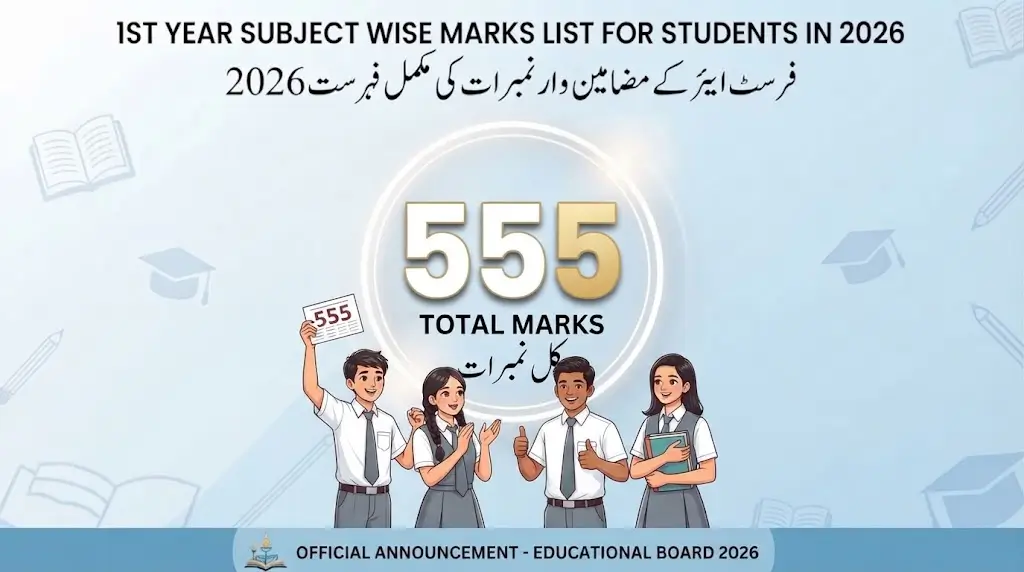
Class 11 Subject-Wise Marks
The elective subjects carry different combinations of theory and practical marks. Science subjects such as Physics, Chemistry, Biology, and Computer Science generally include practical components, while subjects such as Mathematics and Economics are assessed through written papers.
For example, Physics, Chemistry, Biology, and Computer Science commonly have 85 theory marks and 15 practical marks in the overall 100-mark structure under the relevant scheme. Other subjects may have different paper structures.
This distinction is important because students should not assume that every subject is divided into the same number of MCQs, subjective questions, and practical marks.
Total Marks in FSc Part 1
Students enrolled in FSc usually study science subjects along with compulsory subjects. The exact combination depends on whether they are enrolled in the Pre-Medical or Pre-Engineering group.
For a typical FSc Part 1 combination, the major subjects include:
- English – 100 marks
- Urdu – 100 marks
- Islamic Education – 50 marks
- Physics – 85 marks
- Chemistry – 85 marks
- Biology – 85 marks
- Mathematics – 100 marks
Students should check their board’s current scheme because curriculum structures can be revised.
Total Marks in FA Part 1
FA students generally study compulsory subjects along with three elective subjects. The elective combination depends on the group selected by the candidate.
The common structure includes:
- English – 100 marks
- Urdu – 100 marks
- Islamic Education – 50 marks
- Elective Subject 1 – 100 marks
- Elective Subject 2 – 100 marks
- Elective Subject 3 – 100 marks
The actual marks for individual elective subjects should be confirmed from the relevant board’s current syllabus.
Total Marks in ICS Part 1
ICS students generally study Computer Science with Mathematics or another approved combination, along with compulsory subjects.
A commonly used combination includes:
- English – 100 marks
- Urdu – 100 marks
- Islamic Education – 50 marks
- Mathematics – 100 marks
- Physics or Statistics – 100 marks
- Computer Science – 100 marks
The selected combination may differ according to the college and board’s approved scheme.
Total Marks in ICom Part 1
ICom students study commerce-related subjects such as Accounting, Economics, Commerce, and Business Mathematics. The marks distribution can differ between subjects.
Common subjects include:
- English – 100 marks
- Urdu – 100 marks
- Islamic Education – 50 marks
- Principles of Accounting – 100 marks
- Principles of Economics – 75 marks
- Principles of Commerce – 100 marks
- Business Mathematics – 50 marks
Students should use their official admission form or board-issued scheme to confirm their exact subject combination.
How 1st Year Result Is Calculated
The 1st Year marks distribution 2026 is important when calculating a student’s percentage. Marks obtained in individual subjects are added according to the applicable examination scheme.
Students also need to understand that practical marks are counted separately where practical examinations are part of a subject. A student must meet the applicable passing requirements in each subject rather than relying only on the overall percentage.
If a candidate does not pass a subject, the relevant board’s rules determine whether the student needs to appear in a subsequent examination.
Check 1st Year Result 2026 Gazette
After the official announcement of the 1st Year Result 2026, boards generally provide online result-checking facilities. Students may also be able to access the result through a gazette, depending on the board.
The result can normally be checked using the student’s roll number, while some boards also provide SMS-based result services. The gazette is particularly useful for students who want to search for results when they do not have immediate access to the online result portal.
Before checking the result, students should make sure they are using the official website of their respective Board of Intermediate and Secondary Education.
Final Words
Understanding the 1st Year marks distribution 2026 makes it easier for Class 11 students to understand their result cards, calculate percentages, and identify the subjects included in their selected group. However, students should always compare these details with the latest official scheme issued by their board because subject combinations and marks can change with curriculum updates.
Once the 1st Year Result 2026 is announced, students can check their subject-wise marks through the official board portal and, where available, the result gazette.
